Choosing a career is difficult enough without trying to predict what technology will do to the job market.
For today’s students, artificial intelligence has made that decision even more complicated. Software can already write, analyse, summarise, translate, design and generate code. New capabilities are appearing quickly, and it is difficult to know which tasks will still look the same by the time a student finishes university or vocational training.
That does not mean young people should avoid careers that involve technology. In fact, in a potentially unintuitive twist, the opposite may be true.
The Australian labour market is continuing to create opportunities in professional, technical, healthcare, education, management and service occupations. Jobs and Skills Australia projects employment across the country to increase by about 13.3% between May 2025 and May 2035, adding almost two million jobs. Professionals are projected to experience the largest increase among the major occupation groups, while community and personal service roles and managers are also expected to grow strongly.
The more useful question for students is therefore not which jobs will be untouched by AI.
It is which careers are likely to remain valuable as AI becomes part of everyday work.
AI will change careers, but can it eliminate them?
The question facing students is not necessarily whether AI will take their future job. In many cases, the more immediate question is how much of that job will still look the same.
Most occupations are made up of dozens of different tasks. Some are routine and relatively easy to automate, whilst others depend on judgement, experience, communication or circumstances that cannot be neatly anticipated in advance.
An accountant, for example, could spend less time preparing routine reports as software becomes more capable. A marketer might use AI to analyse campaign data or produce an initial set of ideas. A software developer may turn to coding tools to handle some of the more repetitive parts of a project.
The profession does not necessarily disappear when those tasks do, just as autocorrect didn’t do away with the idea of an editor (I write, as a professional editor myself).
The parts that remain may involve deciding what the numbers mean, understanding why a customer is behaving in a particular way, working out why a piece of software is not behaving as expected or deciding what to do when the situation does not fit the information on the screen.
That is one reason the effect of AI on employment is proving harder to describe than some of the early predictions suggested.
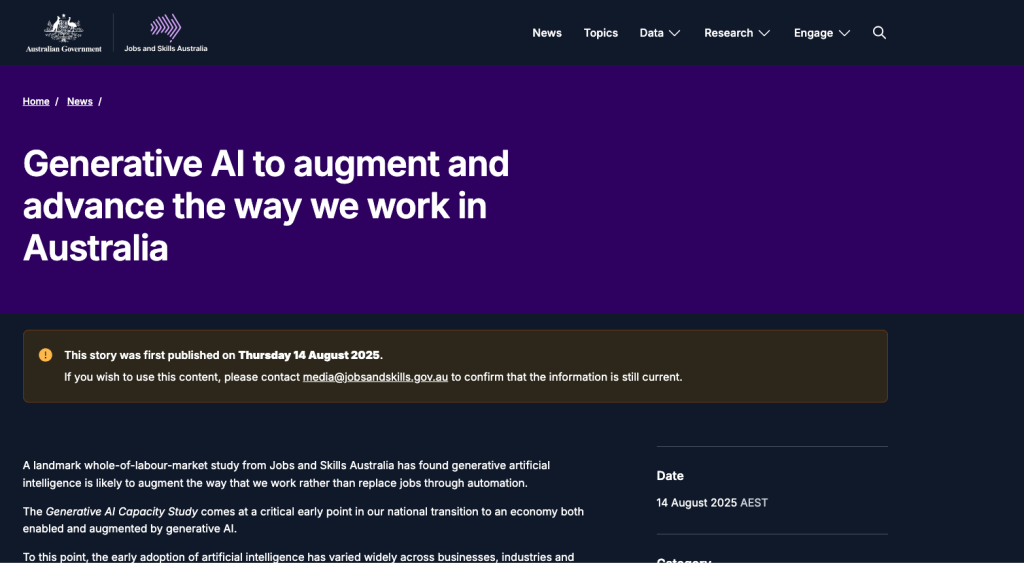
Jobs and Skills Australia has found that generative AI is more likely to change the way many people work than simply remove their jobs altogether. Its research also points to the growing importance of digital skills alongside capabilities such as communication, adaptability and critical thinking.
For students choosing what to study, that distinction matters.
There is little point looking for a career that is completely untouched by technology. A more realistic approach is to consider where technology is likely to take over routine work, and where people will still be needed to make decisions, deal with other people and handle the problems that do not arrive in a predictable format.
The jobs may change. In many cases, the people doing them will have to change with them.
Technology careers will continue to matter
It might seem strange to suggest technology as an option when AI is changing technology jobs so rapidly.
But learning about technology is not the same as competing with technology.
Software developers, cybersecurity professionals, data specialists, systems architects and ICT managers all work in areas where the tools are changing quickly. That creates challenges, but it also creates demand for people who understand how those systems work and how organisations should use them.
Jobs and Skills Australia’s latest projections point to continued growth across a range of ICT and management roles, including ICT managers, even as artificial intelligence changes the nature of many technology jobs.
Cybersecurity is a useful example. As businesses move more of their operations online and rely increasingly on cloud platforms, connected devices, digital payments and other networked services, the consequences of a security failure become more significant. Organisations need people who can assess vulnerabilities, manage risk, respond when systems are compromised and make decisions about how new technologies should be introduced.
AI is adding another layer to that challenge. The same systems that can help businesses automate processes and analyse large amounts of information can also create new security risks, particularly as organisations connect more software and services to their existing infrastructure.
That does not make cybersecurity immune from automation, and the work itself will continue to evolve as the technology changes. It does, however, illustrate why students should be cautious about assuming that a career becomes less relevant simply because the tools used by its professionals are becoming more sophisticated. In some areas of technology, the rapid development of AI may create more work around implementation, oversight, security and risk rather than simply removing the need for people with technical expertise.
Engineering combines technical knowledge with real-world problems
Engineering is another field where the arrival of more capable AI tools does not necessarily translate into fewer jobs. Engineers are already using software to assist with calculations, modelling, simulations and design, and those capabilities are likely to become more sophisticated as AI develops. But much of engineering involves dealing with constraints that exist outside a computer.
A civil engineer working on a road, bridge or building, for example, has to account for the physical conditions of a site as well as safety standards, planning requirements, budgets, materials and environmental considerations. The design may look sound on paper, but it still has to work when it is built and used by the public. Unexpected problems can emerge during construction, and decisions often have to be made with incomplete information or competing demands.
Jobs and Skills Australia’s employment projections also point to continued demand for engineering professionals over the coming decade. For students with an interest in mathematics and science, the attraction is not simply that engineering involves technical knowledge. It is that the knowledge has to be applied to problems in the physical world, where circumstances are rarely as tidy as they appear in a spreadsheet or simulation.
That distinction is likely to matter as AI becomes more capable. The technology may take on more of the calculations and routine design work, but engineers will still need to interpret the results, make decisions and account for what happens when a project moves from a computer model into the real world.
Healthcare offers a wide range of careers
Healthcare is likely to remain one of Australia’s more significant sources of employment growth. Jobs and Skills Australia expects Health Care and Social Assistance to remain the country’s largest employing industry, with growth being driven in part by an ageing population and increasing demand for health services.
For students considering a career in the sector, that growth extends across a surprisingly wide range of professions. Doctors, physiotherapists, psychologists, occupational therapists, pharmacists, speech pathologists, paramedics and other allied health professionals all do very different jobs, but many share a characteristic that is relevant in an age of increasingly capable software: they work with people whose circumstances do not always fit neatly into a standard process.
A physiotherapist may need to adjust an exercise programme based on how a patient responds during a session. A psychologist has to understand not only what a person says, but the circumstances surrounding it. A paramedic can be required to make decisions quickly in an environment where the situation may change from one minute to the next. Across these professions, communication and professional judgement are not separate skills bolted onto the job. They are fundamental to it.
AI is likely to become increasingly useful across healthcare, from analysing information and identifying patterns to preparing documentation and supporting aspects of clinical decision-making. That could change how professionals spend their time and reduce some of the more routine work involved in healthcare, but it does not remove the underlying demand for health services or the responsibility involved in providing them.
For students interested in science, technology and working with people, healthcare is therefore worth considering as a sector rather than simply as a collection of individual occupations. There are careers that involve highly technical work, others that are centred on direct patient care and many that sit somewhere in between. As AI changes the way healthcare is delivered, that breadth could provide students with more ways to find a role that suits their interests and strengths.
Teaching may become more important as AI changes education
Teaching is an interesting career to consider in the age of AI precisely because the technology has created such a strong backlash within education. Across schools and universities, there are growing concerns about students using AI to complete work, whether assessments can still be trusted and what happens to learning when software can produce a polished answer without requiring the student to understand the subject.
The debate has become particularly heated at universities, including the University of Sydney, where staff protests and enterprise bargaining disputes have included concerns about the use of AI and its implications for academic work. The argument goes beyond whether teachers should be allowed to use a new piece of software. At stake is a much more fundamental question about trust: if a university awards a qualification, how can it be certain the student has actually acquired the knowledge and skills that qualification represents?
For someone considering teaching as a career, that tension is significant. AI is very good at producing information, generating exercises and helping with some of the administrative work that consumes a teacher’s time. It is much less straightforward when the job involves recognising why a particular student is struggling, working out how to explain something differently, managing a classroom or building enough trust for a student to admit they do not understand something.
Those parts of teaching are likely to remain important even as AI becomes more capable. In fact, the technology’s difficulties with trust and assessment may place greater value on teachers who can help students develop the ability to think independently, assess information and use AI without simply allowing it to do the thinking for them.
That does not make teaching an AI-proof career, and the profession is unlikely to remain unchanged. Teachers will have to become more familiar with AI tools, schools and universities will continue to reconsider assessment, and some of the routine work associated with teaching may increasingly be automated.
For students weighing up the profession, however, the current backlash is worth paying attention to. It suggests that education is not simply another industry waiting to become more efficient through automation. There is still a strong expectation that teachers will provide something a machine cannot: the human judgement, relationships and accountability that allow students to learn in the first place.
Skilled trades offer a different path into the workforce
For students who are not convinced that a university degree is the obvious route into a career, the skilled trades deserve more attention, particularly as AI changes the nature of office-based work.
Electricians, plumbers, refrigeration mechanics, carpenters and other tradespeople spend much of their working lives dealing with physical environments that rarely behave exactly as expected. A job might begin with one problem and reveal another once the wall is opened, the machinery is inspected or the existing work is uncovered. Plans can be incomplete, buildings can have been modified over the years and the solution that looks straightforward on paper may not be the one that works on site.
Technology can certainly help. Tradespeople already use digital tools for planning and quoting, diagnostic equipment to identify faults and increasingly sophisticated machinery to make parts of their work more efficient. AI is likely to add to those capabilities. But the technology still has to be applied to a physical problem by someone who can assess the situation, make a decision and carry out the work.
That makes the trades an interesting option for students thinking about the future of work. The appeal is not that a plumber or electrician will somehow be untouched by technological change. It is that the work combines technical knowledge with practical judgement and physical activity in environments that are difficult to standardise.
There are also significant differences in how people enter these careers. An apprenticeship can combine paid employment with structured training, allowing someone to develop a trade without spending several years in a conventional university programme. For students who prefer practical learning, that can be an important consideration in its own right.
The trades are not immune to economic conditions, either. Construction cycles, regional demand, specialisation and experience all influence employment opportunities and earnings. But for someone deciding what kind of work they want to build a career around, the trades offer something increasingly relevant in an AI-driven economy: a profession where knowing how to solve a problem in the real world can be just as important as knowing how to describe it on a screen.
Marketing is becoming a more human profession
Marketing may be one of the clearest examples of how AI can simultaneously make a profession easier and more difficult.
There is now very little that a marketer cannot ask an AI system to produce. It can write an advertising concept, generate social media copy, create an image, analyse campaign data, suggest keywords and produce dozens of variations on an idea in the time it once took to make a single draft.
That has changed the baseline of the industry. Work that once required a designer, copywriter or junior marketer can increasingly be produced in minutes, and businesses have understandably started asking what they should still be paying creative professionals to do.
At Trafficon Digital, we have seen the other side of that equation. We continue to use human creatives for our social, design and advertising work because the ability to produce something quickly is not the same as producing something that people actually want to engage with.
The more convincing generative AI has become, the harder that distinction has become to make at a glance. People can encounter an image or piece of content online without knowing whether a person created it or a machine did. In response, there is an increasing tendency to question content that feels generic, overly polished or artificial, particularly when it is being used to sell something.
Research has also found significant consumer resistance to AI-generated creative work. Studies as early as 2023 have reported negative attitudes towards generative AI in areas such as visual design, while consumers have shown a reluctance to place the same value on AI-generated creative products as those produced by people. That creates a particularly awkward situation for boutique advertising, where the creative work is often the product being sold.
The irony is that AI has made it easier for almost anyone to produce something that looks like marketing, while making it harder to produce marketing that feels distinctive.
For someone considering marketing as a career, that changes what is worth learning. Knowing how to use AI tools will increasingly be part of the job, but it is unlikely to be enough on its own. Marketers still need to understand an audience, recognise what makes a business different, develop a credible brand and make decisions about what is worth saying and where it should be said. They also need to know when not to use AI.
A generated image might be technically impressive but completely wrong for a brand. An AI-written advertisement might contain all the right keywords while saying nothing that makes a customer care. A campaign can be perfectly optimised and still fail because the underlying idea is forgettable.
That is where marketing remains a distinctly human profession. The technology can help produce and refine the work, but deciding what deserves to exist in the first place still requires taste, context and an understanding of people.
For students interested in marketing, business and creative work, that may be one of the more important changes to understand. AI is unlikely to remove the need for marketers, but it is raising the standard for what marketers are expected to contribute. When almost anyone can generate an acceptable piece of content, the value increasingly lies in knowing what is worth creating, why it matters and how to make people stop scrolling long enough to notice it.
Management and leadership will not disappear
As technology takes over more routine tasks, organisations still need people to decide what should happen next.
Managers coordinate teams, allocate resources, set priorities, handle conflicts and make decisions when there is incomplete information.
AI can provide analysis and recommendations. It cannot remove the need for organisations to decide which goals matter or who should be responsible for achieving them.
Jobs and Skills Australia projects Managers to grow strongly between 2025 and 2035, with particularly significant projected growth in areas including ICT management and health and welfare services management.
Management is not necessarily a career people enter immediately after finishing school or university. It is often something people move into after developing expertise in another field.
That makes it another reason to think about career planning as a long-term process rather than simply choosing a first job.
What should students look for in an AI-resistant career?
There is no reliable checklist that can identify the careers AI will never affect.
There are, however, some characteristics worth considering.
Work that requires human interaction
Jobs involving patients, students, clients, customers or teams often require communication and judgement that cannot be reduced to a standard process.
Work that takes place in unpredictable physical environments
Construction, maintenance, electrical work, plumbing and many other trades involve real-world conditions that vary from one job to the next.
Work involving responsibility and decision-making
In many professions, someone still needs to interpret information and accept responsibility for the outcome.
Work requiring specialist knowledge
Deep expertise can remain valuable even when AI makes general information easier to access.
Work that combines several types of skill
A career that requires technical knowledge alongside communication, creativity, leadership or practical judgement may provide more ways for a person to adapt as technology changes.
None of these characteristics makes an occupation immune to automation.
They simply provide a better way to think about how work may evolve.
Don’t choose a career based on growth figures alone
Employment projections are useful, but they should not become the only factor in a student’s decision.
Jobs and Skills Australia’s projections are based on assumptions about future economic and labour-market conditions. They indicate potential trends rather than providing a guarantee of what will happen.
Students should therefore ask several questions.
- How long does it take to qualify?
- How much does the training cost?
- Will the qualification provide several possible career paths?
- What does a normal working day actually look like?
- Are there opportunities to work while studying?
- What skills will need to be updated throughout the career?
And perhaps most importantly, will the person still want to do the job after the novelty of the career title has worn off?
A projected shortage of workers does not make a career suitable for everyone.
What should students actually look for in a career?
For students trying to work out what to do after school, the difficulty is not finding a list of occupations that have been labelled “AI-proof”. There probably is not one, and any list claiming otherwise is likely to become outdated quickly.
The more useful exercise is to look at what a career actually involves.
A job that currently has strong demand may still be a poor choice if the training is prohibitively expensive, the working conditions are unsuitable or the day-to-day work bears little resemblance to what a student imagined. Equally, an occupation that is not among the fastest-growing may offer a long and productive career if it requires expertise that remains valuable and provides opportunities to adapt as the industry changes.
That means looking beyond employment projections. Students should consider how long it takes to qualify, what the training costs, whether there are opportunities to earn while learning and what further qualifications might open up later. They should also look closely at the work itself. A career in healthcare is very different from one in engineering, even though both may benefit from growing demand. Marketing, teaching and the trades bring their own demands, rewards and frustrations.
The effect of AI is another part of that calculation, but it should not be treated as the only one.
In some professions, AI will probably remove routine tasks. In others, it may become an important tool without fundamentally changing the nature of the work. There will also be industries where the technology creates entirely new responsibilities that are difficult to anticipate today.
That makes adaptability useful, but the word is sometimes used so loosely that it loses its meaning. Being adaptable does not simply mean learning how to use the latest AI application. It means developing enough knowledge of a profession to recognise when the technology is useful, when it is producing something unreliable and when a problem requires a person to step in.
For a student choosing a career now, that may be a more realistic form of job security than trying to predict which occupations will survive unchanged.
The labour market will continue to move. Some jobs will disappear, others will emerge and many of the careers that exist today will gradually change shape. The students who enter that market will probably change jobs, learn new systems and acquire new skills several times over the course of their working lives.
That is not necessarily a reason to be pessimistic about the future of work. It is simply a reason to be more deliberate about what makes a career worth pursuing in the first place.
The most useful question may therefore be less about whether AI can do a particular job and more about whether the career gives someone the opportunity to develop expertise, solve meaningful problems, work with other people and continue learning as the nature of the work changes.
For students standing at the beginning of their working lives, that is a considerably broader set of options than any list of “AI-proof” jobs could provide.