I have been working in SEO for around 11 years, which is long enough to have seen the industry declare the death of SEO more times than I can reasonably remember.
Every few years, something changes and the same panic starts again. Google releases a major algorithm update, a new search feature appears, a social platform changes the way it distributes content, or some new technology threatens to fundamentally alter how people find information online. Almost immediately, someone announces that everything we have learned about SEO is now obsolete and that anyone who wants to remain relevant needs to completely reinvent themselves.
To put it mildly, I have never found that way of navigating the world particularly useful. My general rule is that if someone has to scream at you that your industry is dead every 10 seconds, then they have some sort of vested interest in making you think it so.
Nevertheless, the arrival of generative AI has produced perhaps the strongest version of that panicked reaction yet, in no small part because the ease of typing “Hey ChatGPT, write me an article about how ChatGPT will steal my job and destroy my industry” is as tantalising as it is deeply ironic. Search is clearly changing, as the old model of typing a few words into Google and working through a page of blue links is giving way to something more conversational, more complicated and, depending on your personal tolerance for AI, sometimes considerably more irritating.

Google now has AI Overviews and AI Mode, while platforms such as Perplexity have built search and research experiences around AI-generated answers. These systems can take a relatively complicated question, break it down into a series of related searches, gather information from multiple sources and then present the result as a single response with around a 65% to 85% accuracy rate depending on who you ask.
Google calls one part of this process “query fan-out”. Rather than treating a user’s query as one isolated search, AI Mode can break it into multiple related searches and investigate different parts of the question before constructing its answer. Google says this allows AI Mode to explore the web more deeply than a traditional search. It is also now part of Google’s Search experience in Australia.
This is a significant change to how people interact with search, but it has also created a new question for the SEO industry: has GEO finally killed SEO?
GEO, or Generative Engine Optimisation, has quickly become one of the industry’s favourite new acronyms. The basic idea is straightforward enough. Traditional SEO is concerned with making a website visible in search results, whereas GEO is concerned with making information from that website more likely to appear in the answers produced by generative AI systems.
That sounds like a fundamental distinction, but as the forever skeptic, I am not fully convinced that it is.
The search box has changed, sure, but how much does that mean?
The mistake is to assume that because the interface has changed, the underlying mechanics of being discoverable have somehow been replaced.
The idea that AI is working off an entirely different system of qualifiers when compared to the Google algorithm tends to assume that the two are entirely different, when in actuality, these algorithmic systems are essentially built off of the same frameworks, with one acting as a pointer and the other a synthesis machine.
Google still needs to find information somehow, and it’s not particularly invested in the idea of feeding users an endless sea of regurgitated Forbes articles written by AI.
AI systems that search the web, in turn, still need to find information. Perplexity describes its own Pro Search system as conducting multiple searches across the web before synthesising information from those sources into an answer. Google’s AI Mode similarly uses multiple related searches to investigate a question.
The interface may be different, and the final product may be an answer rather than a list of links, but somewhere along the way the system still has to determine which information is relevant, which sources are useful and which material is credible enough to incorporate into the response.
That is where I think a lot of the discussion around GEO becomes unnecessarily complicated, and we can end up in arguments and mired in nuances that, at the end of the day, none of us have solid concrete facts about given the opaque “black box” nature of how these systems operate.
There are certainly new things to think about, it’s not all going to be the same “link me here 10,000 times and get me page 1” it was in 2015. An AI system may interpret a question differently from a conventional search engine. A long conversational prompt can contain several related questions that need to be investigated separately. The system may retrieve information from a much broader collection of sources before deciding what to include. The final answer may also synthesise information from several pages rather than sending the user to one result, and those differences do matter.
However, what they do not mean is that every lesson we have learned about making a website useful, understandable, technically accessible and authoritative has suddenly become irrelevant.
If anything, the increasing complexity of AI search makes those fundamentals more important.
Query fan-out is not as revolutionary as it sounds
Query fan-out is a good example of how the language surrounding AI can make a fairly familiar search process sound considerably more revolutionary, and in turn convoluted, than it actually is.
Imagine someone searches for “best accountants for small businesses in Brisbane”. A good SEO strategy does not simply look at those six words and try to build a page around them. It considers what the person is actually trying to find, the questions they are likely to have, the information they will need before making a decision and the other searches they might conduct along the way. Location, services, pricing, qualifications, industry specialisation, reputation and the differences between competing firms all become relevant to understanding the searcher’s intent.
Now imagine that the same person asks an AI system something more conversational: “I run a small construction company in Brisbane and need an accountant who understands BAS, payroll, tax and the particular accounting issues that come with construction businesses. What should I look for and which firms should I consider?”
That is obviously a more complicated request, and an AI system may need to break it down into several separate information requirements before it can produce a useful response. It might need to establish what accounting services are relevant to construction businesses, identify the particular tax and compliance issues involved, establish the location, find firms that work with construction companies and then assess which of those businesses appear relevant to the original request.
This process is generally referred to as query fan-out. Rather than treating the user’s prompt as one isolated search, the system effectively turns it into a series of related searches or information-gathering tasks and uses the results to construct an answer.
The important point for SEOs is that the underlying idea is not particularly new.
For years, we have talked about search intent and the importance of understanding what someone actually wants when they enter a query. We have built content around long-tail searches, related questions, semantic relationships, topic clusters, entities and the different stages of the customer journey. We have looked beyond the exact words typed into a search box because the words themselves have never been the entire story.
Query fan-out simply makes that process more visible because the system is doing some of the work itself.
This is one of the reasons I am sceptical when the GEO industry presents every new terminology change as evidence that SEO has become an entirely different discipline. There are certainly new technical considerations when a business is trying to appear in an AI-generated answer, and the way these systems retrieve, evaluate and synthesise information deserves to be understood. What is less convincing is the suggestion that experienced SEOs need to throw away everything they have learned about search intent and start again because an AI system has learned to ask several related questions.
If anything, query fan-out reinforces one of the oldest lessons in SEO: you need to understand the subject rather than simply the keyword.
A business that publishes a page targeting “accountants Brisbane” but says nothing useful about the services it provides, the industries it works with, the problems it solves or why a customer should trust it is unlikely to become particularly authoritative simply because the page has been optimised around the phrase. The same weakness becomes apparent when an AI system is trying to determine whether that business is actually relevant to a much more detailed request.
This is where GEO does have a useful distinction from traditional SEO. The objective is not necessarily to get a particular page into a particular position on a search results page. Instead, the objective may be for the information about a business to be understood, retrieved and incorporated into an answer generated in response to a much more complicated request.
Academic research has already begun treating Generative Engine Optimisation as a distinct optimisation problem, particularly in relation to visibility within generated responses rather than conventional search rankings. That is worth paying attention to, because the measurement and mechanics of visibility can differ when an AI system is selecting and synthesising information rather than simply presenting a list of ranked webpages.
The mistake is to assume that the existence of a new mechanism means everything that came before it has become irrelevant.
Query fan-out is a useful development to understand, particularly for anyone working in GEO, but the principle behind it should be familiar to anyone who has spent much time doing SEO properly. People rarely have just one information need, even when they type only a few words into Google. The difference is that AI systems are increasingly capable of working through those related needs on the user’s behalf.
For marketers, that makes understanding the subject matter, the audience and the wider search journey more important, not less. It also makes the idea of producing one thin page for one keyword look increasingly dated, which is hardly a revolutionary development for anyone who has been paying attention to SEO for the past decade.
The terminology may be new, and the technology behind it is certainly more sophisticated, but the underlying principle is as familiar as every little update to our playbook. All you need to do is understand the question behind the query and provide information that genuinely helps answer it.
Google is already blurring the line
There is another reason I am reluctant to treat SEO and GEO as two completely separate disciplines: Google itself is making the distinction increasingly difficult to maintain.
Google’s AI Mode is not a separate internet that exists alongside Search. It is being built directly into the search experience, using Google’s existing search infrastructure and information systems alongside Gemini. Google has also described AI Mode as drawing on its core quality and ranking systems, while using techniques such as query fan-out to handle more complex searches.
That makes the idea that GEO has somehow replaced SEO rather difficult to reconcile with what Google is actually building.
If the world’s dominant search engine is incorporating generative AI into its existing search infrastructure, the more likely outcome is not an abrupt transition from SEO to GEO, but an evolution of search in which traditional organic results, AI-generated answers and other search features increasingly exist alongside one another.
For marketers, that distinction matters because it changes what we are actually optimising for. A business may still need to rank in conventional search results, while also making sure its website contains information that can be understood and retrieved when an AI system is assembling an answer. Those are not necessarily competing objectives, particularly when both systems are drawing on many of the same underlying signals about relevance, authority, quality and trust.
The relationship becomes even more obvious when you look at AI platforms that retrieve information from the web themselves. Perplexity, for example, describes its search process as carrying out multiple web searches and synthesising information from the resulting sources, with citations and links that allow users to examine where the answer came from.
The website, therefore, has not disappeared from the process simply because the interface has changed. What has changed is the way the user may encounter the information.
Someone searching Google traditionally might see a business listed among a page of results, decide which link looks relevant and visit the website themselves. Someone using an AI search product may instead receive a paragraph that incorporates information from several websites, with the underlying sources presented as citations. In both cases, however, the system needs to find, understand and evaluate information before it can put that information in front of the user.
That is an important distinction when considering the future of SEO. The search result may no longer always look like a list of ten links, but the underlying web has not ceased to matter. If anything, businesses have another reason to make sure their websites are technically accessible, factually useful, authoritative and clear about what they actually do.
The interface is changing faster than the fundamental problem. People still need information, search systems still need to find it, and businesses still need to make themselves discoverable.
GEO is part of that evolution, but calling it the replacement for SEO risks missing what is actually happening. Google is not abandoning search optimisation and handing the internet over to a completely separate generative system. It is instead incorporating generative capabilities into Search itself, which makes the future look much more like an expansion of the search environment than the death of the one that came before it.
The real change is what happens after someone finds you
This is where I think the GEO discussion becomes considerably more interesting, because the biggest change may not be how information is discovered, but what happens after it has been discovered.
Traditional SEO has generally operated around a fairly straightforward model. Someone searches for something, your website appears in the results, they decide that your listing is relevant enough to click and you then have the opportunity to turn that visit into a lead, a sale or some other form of conversion.
Generative search can disrupt that sequence because the system may provide enough of an answer that the user has no immediate reason to visit the source.
Someone might ask an AI system which accounting software is suitable for a particular type of business, receive an answer that draws on information from several websites and make a decision without visiting any of them. Your business could be mentioned, your research could be cited or your information could contribute to the answer, yet the resulting referral traffic could look very different from what you would expect from a conventional search result.
That is a significant change for businesses that have historically measured the value of SEO largely through rankings, clicks and organic sessions.
It also creates a measurement problem. If a customer discovers your business through an AI-generated response, remembers the name and later searches for it directly, the original AI interaction may not be particularly obvious in your analytics. A company can therefore gain visibility and influence without necessarily seeing a corresponding increase in the kind of referral traffic that traditional SEO reporting has been built around.
Even so, it would be premature to conclude that AI answers have made websites irrelevant.
Google continues to include links and source information within its AI experiences, and the company has been experimenting with ways to help users move from generated answers to the original websites and content behind them. The broader direction of travel is therefore more complicated than the simple idea that AI will answer every question and remove the need for people to visit websites.
What is changing is the relationship between being discovered and receiving a click.
For marketers, that means visibility may increasingly have several different forms. A business might rank in a conventional search result, appear in an AI-generated response, be cited as a source, have its information used to construct an answer or become the subject of a subsequent branded search. These outcomes do not necessarily produce the same immediate traffic, but they can all form part of the way a potential customer encounters a business online.
That is why I think the discussion around GEO needs to move beyond the question of whether a business can “rank” in ChatGPT or another AI platform. The more useful question is whether the information surrounding that business is strong enough to be discovered, understood and considered relevant when someone asks a question that could lead them towards its products or services.
SEO has always been about visibility, but visibility was relatively easy to conceptualise when the primary outcome was a blue link and a click. Generative search is making that relationship less direct, which means businesses will need to think more carefully about what visibility is worth, how it should be measured and what happens between someone first encountering a brand and eventually becoming a customer.
The click has not disappeared, and websites certainly have not disappeared with it. What has changed is that there are now more steps between being found and getting the visitor.
There is no secret GEO hack
This is probably the point in the article where I am supposed to reveal the five GEO techniques that will allow your business to dominate ChatGPT, although if such a list existed I suspect it would already be circulating around the marketing industry for the same two weeks before somebody found a way to make it obsolete. The reality is that there are certainly experiments worth paying attention to, particularly around how AI systems retrieve information, interpret sources and decide what to include in a generated response, but I am yet to see convincing evidence that there is a secret formula for consistently manipulating those systems in the way that some of the more breathless GEO commentary suggests.
There will always be people testing different approaches to citations, formatting, entities, statistics, quotations, authorship and the structure of information, and some of that work will undoubtedly teach us something useful about how generative search behaves. That is no different from what has happened throughout the history of SEO, where marketers have tested everything from keyword density to link structures in an attempt to understand how search engines interpret and rank information. Some techniques have turned out to be useful, others have worked briefly before being neutralised, and plenty have amounted to little more than SEO snake oil with a new acronym attached.
The more useful question is what all of these systems are ultimately trying to accomplish. Google, ChatGPT, Perplexity and other AI-powered search products need to identify information that is relevant to the question being asked, determine which sources are worth relying upon and present an answer that is useful enough for the user to trust the system and continue using it. The technology used to arrive at that answer may be considerably more sophisticated than traditional search, but that does not change the basic value of having something genuinely useful to contribute.
For businesses, that means the fundamentals remain remarkably familiar. You still need information that answers real questions, a website that can be understood and accessed by search systems, evidence that your organisation knows what it is talking about and enough authority to distinguish your material from the enormous amount of generic content now being produced. The difference is that an AI system may have more ways of finding, combining and presenting that information than a traditional search engine did, which makes understanding those systems worthwhile without necessarily requiring an entirely new philosophy of digital marketing.
There is a certain irony in an industry that spent years telling businesses not to chase Google’s algorithm now encouraging them to chase every perceived quirk of an AI model. If the lesson of the past decade has taught us anything, it is that strategies built around trying to exploit temporary weaknesses in a platform tend to have a shorter lifespan than strategies built around producing something people actually want to find.
That is particularly important now because generative AI has made producing plausible content extraordinarily cheap. The internet does not have a shortage of words, and it certainly does not need another thousand articles explaining the same subject in slightly different language. What is becoming harder to find is expertise, original thinking, useful experience and information that exists because somebody actually knows something rather than because a prompt was entered into a content generator.
For that reason, I do not think the answer to GEO is to become obsessed with finding the latest optimisation trick. The more durable approach is to understand how these systems discover and interpret information while continuing to do what good SEO has always required: create something worth finding in the first place.
None of that makes for a particularly exciting conference presentation, because there is no magic combination of headings, statistics and carefully placed phrases that suddenly turns an otherwise unremarkable website into an authority. It does, however, make considerably more sense than chasing every new GEO trick that appears on LinkedIn.
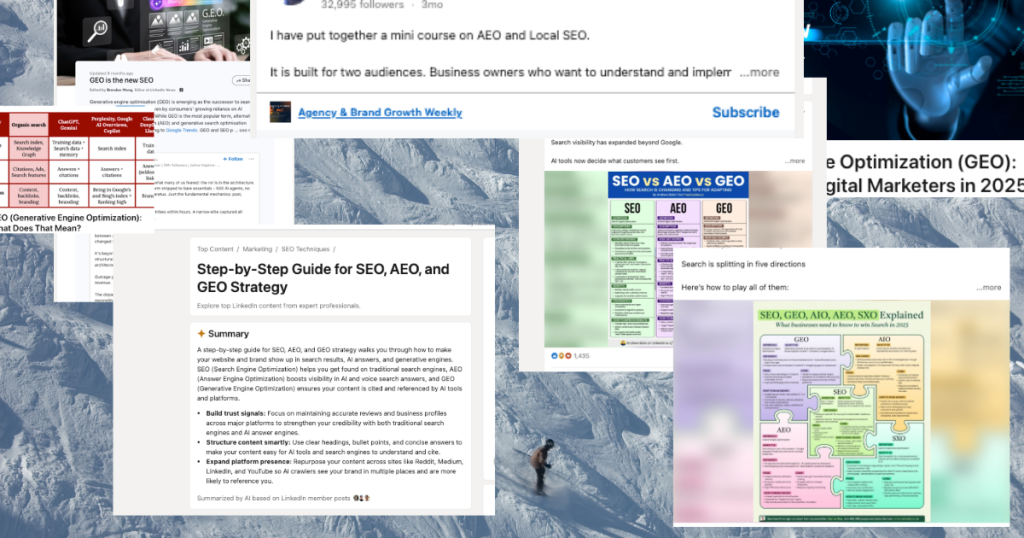
The real opportunity is therefore not to find a way to game AI platforms before they change again. It is to build the kind of website and content that deserves to be found in the first place. That has always been the underlying principle of good SEO, and there is little reason to believe it has suddenly become obsolete simply because the interface through which people find information is changing.
Good SEO still looks remarkably like good GEO
This is probably where my position differs from some of the more dramatic predictions being made about GEO. If you have spent years doing SEO properly, a surprising amount of what you already know still applies.
A technically sound website still matters. So does producing useful content that answers the questions people are actually asking, understanding the audience rather than writing mechanically around a keyword, demonstrating genuine expertise and building authority that extends beyond the pages of the website itself. The information still needs to be understandable to both people and the systems attempting to interpret it, and a business with a genuine reputation is still going to have an advantage over one that exists largely as a collection of optimised web pages.
Where things are becoming more difficult is in the distinction between producing content and having something worth saying.
If ten thousand businesses can ask an AI system to produce an article about the benefits of digital marketing and have a reasonably polished version in front of them five minutes later, there is very little value in being business number ten thousand and one to publish essentially the same article. The fact that the writing is grammatically correct, contains the right keywords and follows a sensible heading structure does not make it useful.
The businesses that have something genuinely interesting to contribute have a much better opportunity to stand out. That might come from original research or data that is not available elsewhere, but it can just as easily come from years of first-hand experience, a particularly useful explanation of a complicated subject, a strong argument supported by evidence or simply an understanding of an industry that allows you to explain what everyone else keeps getting wrong.
None of those things are new requirements for SEO, and that is precisely the point. They are the characteristics that have always separated genuinely valuable content from pages that were written primarily because someone decided the business needed another blog post.
What has changed is the scale of the problem. The internet is now capable of producing an enormous amount of plausible-sounding material at very little cost, which means being technically competent is no longer enough to make a piece of content stand out. When almost everyone can produce something that looks acceptable, the businesses with something original, useful or authoritative to contribute have considerably more to gain from making that contribution visible.
That is why I am reluctant to describe GEO as the death of SEO. In many respects, it is forcing us to take the better parts of SEO more seriously. The technical foundations still matter, but so does the substance sitting on top of them. If anything, the arrival of generative AI has made the difference between having content and having something worth saying much harder to ignore.
So, do you need to learn GEO?
Yes, but probably not in the way that some people in the industry would have you believe.
If you work in SEO, you should understand how AI-driven search is changing the way people discover information. That means paying attention to developments such as Google’s AI Overviews and AI Mode, understanding how systems use techniques such as query fan-out to interpret more complex searches, and becoming familiar with the way generative platforms retrieve, assess and synthesise information from multiple sources.
It also means paying attention to what is happening to your clients. Where are they appearing in AI-generated answers? Which pages are being referenced? Are people still clicking through to the website in the same numbers, or are they finding what they need without visiting at all? How is search behaviour changing as people become more comfortable asking increasingly detailed questions rather than typing a few keywords into a search box?
Those are all legitimate questions for an SEO professional to be asking, because visibility is no longer confined to a traditional position in a list of search results. A business can now be encountered through an AI-generated response, a summary, a recommendation or a citation before a potential customer ever sees the conventional results underneath it.
What I would not recommend is throwing away a decade of SEO knowledge and starting again because someone has decided that GEO is the new SEO. It is not a completely separate discipline that has suddenly appeared from nowhere, nor does learning a new acronym require us to forget everything we already understand about search.
GEO is another development in the much larger problem that SEO has always been trying to solve: helping people find useful, relevant and trustworthy information when they need it.
The technology through which people find that information is changing quickly, and the way we measure visibility will have to change with it. The underlying objective has not changed nearly as much as the industry conversation sometimes suggests.
SEO is not dead, but it is changing
After more than a decade working in SEO, I have become fairly resistant to declarations that the industry is on the verge of collapse. Every major change to search seems to produce the same cycle of excitement, anxiety and predictions that the old way of doing things is finally finished. I remember the panic around major algorithm updates, featured snippets, voice search (oh god voice search. Only in writing did I remember that small but panicked blip in my agency career) and mobile-first indexing, each of which was presented at various points as a development that would fundamentally alter or even destroy SEO as a profession.
Some of those changes did force marketers to abandon tactics that had stopped working, and there were certainly businesses and agencies that struggled as a result. What did not happen was the disappearance of SEO. The industry adapted, the definition of good SEO changed, and people who understood why search engines were changing were generally better placed to adapt alongside them.
AI is likely to produce another version of the same cycle, although there is a reasonable argument that this time the change is more significant. Search is no longer necessarily presenting a person with ten blue links and asking them to work through the results themselves. Google is increasingly incorporating generated answers into its results, while services such as ChatGPT, Claude, Gemini and Perplexity can retrieve information, break a question into a series of related queries and present the result as a conversational answer.
That represents a meaningful change in how people encounter information, and it creates legitimate questions for anyone working in search. If someone asks an AI system for recommendations rather than searching through individual websites, how does a business become visible? If the user receives the answer without clicking through to a website, what does organic visibility even mean? And if generative systems are increasingly deciding which information to retrieve and present, does the work of optimising a website need to change with them?
I think the answer to the last question is yes, but considerably less dramatically than some of the current discussion around GEO would suggest.
I also have fairly well-documented reservations about the direction in which AI is taking the internet. I do not particularly like the idea that every search, creative decision and piece of communication needs an AI layer inserted between a person and the thing they are trying to understand. There are legitimate concerns around trust, misinformation, originality and what happens to the quality of the web when producing plausible but mediocre content becomes almost costless.
Those concerns do not make the technology irrelevant to our work. If anything, they make understanding it more important.
At Trafficon Digital, we still need to understand what Google is doing, how AI search is developing and how people are actually finding businesses online. If generative search becomes an increasingly important part of that process, then we need to understand how businesses can perform well within it.
That is why we offer GEO services. It is not because we think SEO has suddenly become obsolete, nor because we believe there is some secret formula that will persuade ChatGPT to recommend a particular business. It is because the search environment is changing, and part of our job is to understand those changes before they become problems for our clients.
The distinction between SEO and GEO is real, but I think it is considerably narrower than the current marketing conversation sometimes makes it sound. SEO has traditionally been concerned with making information discoverable through search engines, while GEO is concerned with making information useful and discoverable within generative search experiences. The systems involved are becoming more sophisticated, the queries are often more conversational and the final result may look very different from a conventional search results page.
The underlying challenge, however, has not changed nearly as much as the interface has.
Businesses still need useful information, genuine expertise, a technically sound website and a reason for people to trust what they are saying. They still need to understand their audience and the questions that the audience is actually trying to answer. They still need to establish authority rather than simply producing pages because somebody has identified another keyword to target.
In fact, those fundamentals may become more important as AI-generated content fills the web with increasingly similar material.
If your business has useful information, genuine expertise, a technically sound website and something meaningful to contribute, you have not suddenly become irrelevant because somebody has put an AI interface between a user and a search query. You have another search environment to understand, another way in which your reputation and information can be evaluated, and another reason to make sure the material you publish is actually worth finding.
For anyone who has been doing SEO properly for the past decade, that should sound considerably less frightening than the latest round of “SEO is dead” headlines might suggest. The tools are changing, the interfaces are changing and the way people discover information is changing, but the fundamental job remains remarkably familiar: understand what people need, provide something genuinely useful and make it possible for the systems connecting those people with information to understand what you have to offer.